






OUR TEAM
ABOUT US
Analitica employs people with mineralogical, geological, chemical and environmental expertise, with the aim of meeting the demands of companies and public bodies working in the field of minerals, industrial geomaterials, georesources and cultural heritage.
The laboratory performs mineralogical, chemical and environmental analyses by means of X-ray diffraction (XRD), X-ray Fluorescence (XRF), Scanning Electron Microscopy and Microanalysis (SEM-EDS), optical microscopy and thermal analyses by means of thermogravimetry.
The laboratory carries out research, consultancy and technology transfer to industries in the mineralogical, geological and environmental fields.
FRANCESCO DELLISANTI
PhD, earth science
CEO and founder, minerals & raw materials


STEFANO MAGURNO
MSc, geology and land managment (curriculum georesources)
Petrography & microscopy
MICHELANGELO POLISI
PhD, models and methods for material and environmental sciences
Cristallography & minerals
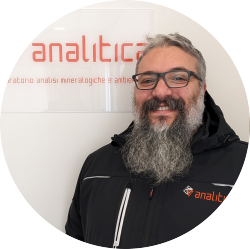
FEDERICO BARELLA
MSc, geological sciences
Environmental monitoring
Mineralogical analyses of rocks, minerals and industrial materials (EN 13925/2006) using the Rietveld method and calibration curves.
Morphological-textural analysis and chemical microanalysis of rocks, minerals, metals.
Elemental chemical analyses of rocks, soils and waste.
Mineralogical, petrographic and textural analyses in thin sections of rocks, mortars, aggregates.
Environmental analyses of asbestos in rocks, soils and materials by phase-contrast optical microscopy.
Study of the thermal behaviour of ceramic materials, raw materials, rocks and minerals
Analysis of crystalline free silica and asbestos